Right now, a parent in your school is losing trust in you. Not because you are doing a bad job, but because they cannot see the job you are doing. No updates. No visibility. No answers when they ask simple questions about fees or results.
Online school management tools fix this, and more. But most schools in Nigeria are still running on paper registers, manual spreadsheets, and good intentions, and it is costing them more than they realize.
This article will show you exactly what online school management tools solve, what to look for before you commit to one, and why the right choice could be the best decision your school makes this year.
Read Also : How Digital School Management Platforms Boost Student Achievement
The Real Problem Is Not That Schools Are Offline
Most Nigerian secondary school administrators are working harder than they need to. The bursar is balancing fee records in a spreadsheet that has not been updated in two weeks. The vice principal is tracking student attendance through paper registers that go missing during exams. The principal is fielding calls from angry parents asking about results that have not been compiled yet.
None of this is a human failure. It is a system failure. No amount of working harder fixes a broken process. You need a better process.
Research on Nigerian secondary school administration consistently points to inadequate ICT infrastructure, manual record keeping, and poor communication between schools and parents as long-standing challenges. These are not new problems. Schools have lived with them for years because no one gave them a practical way out.
Online school management tools are built to fix these things. Not all of them fix everything equally well, which is why knowing what to look for matters.
What Online School Management Tools Actually Do
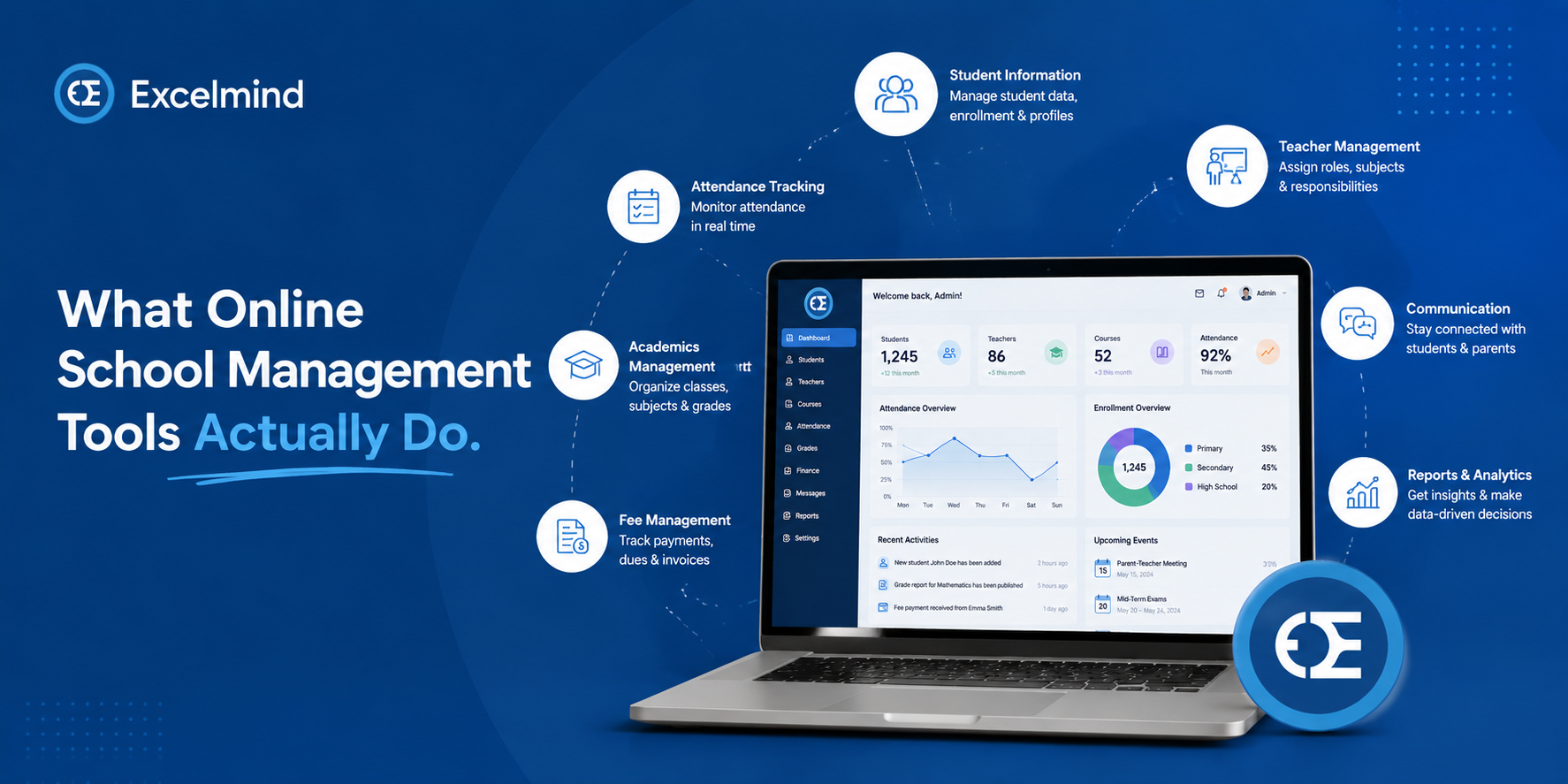
At the most basic level, these tools move your school’s core operations from paper and manual processes to a platform that admin staff, teachers, and parents can all access from a browser or a phone.
Here is what a good platform handles:
- Student records and admission management: every student’s data, stored cleanly and retrievable in seconds.
- Fee payment and accounting: tracking who has paid, who has not, and sending automated reminders to parents.
- Attendance tracking: teachers record attendance digitally and patterns are visible at a glance.
- Result computation: grades entered, results computed automatically, report cards generated without manual errors.
- Timetable management: schedules built and updated without the usual back and forth.
- Parent communication: notifications, progress updates, and announcements sent directly to parents.
- Staff and payroll management: staff records, salary processing, and leave tracking in one place.
- Lesson notes and assignments: teachers upload materials, students access them, and feedback is tracked.
- CBT examinations: computer-based tests conducted within the platform.
- Hostel management: for boarding schools, tracking accommodation and student movement.
When these functions work together on one platform, your staff spends less time on administration and more time on actual school work. Parents get the visibility they have always wanted. And you, as the school owner or principal, can see the health of your school at a glance instead of waiting for end-of-term reports.
What Most Nigerian Schools Have Not Thought About But Should
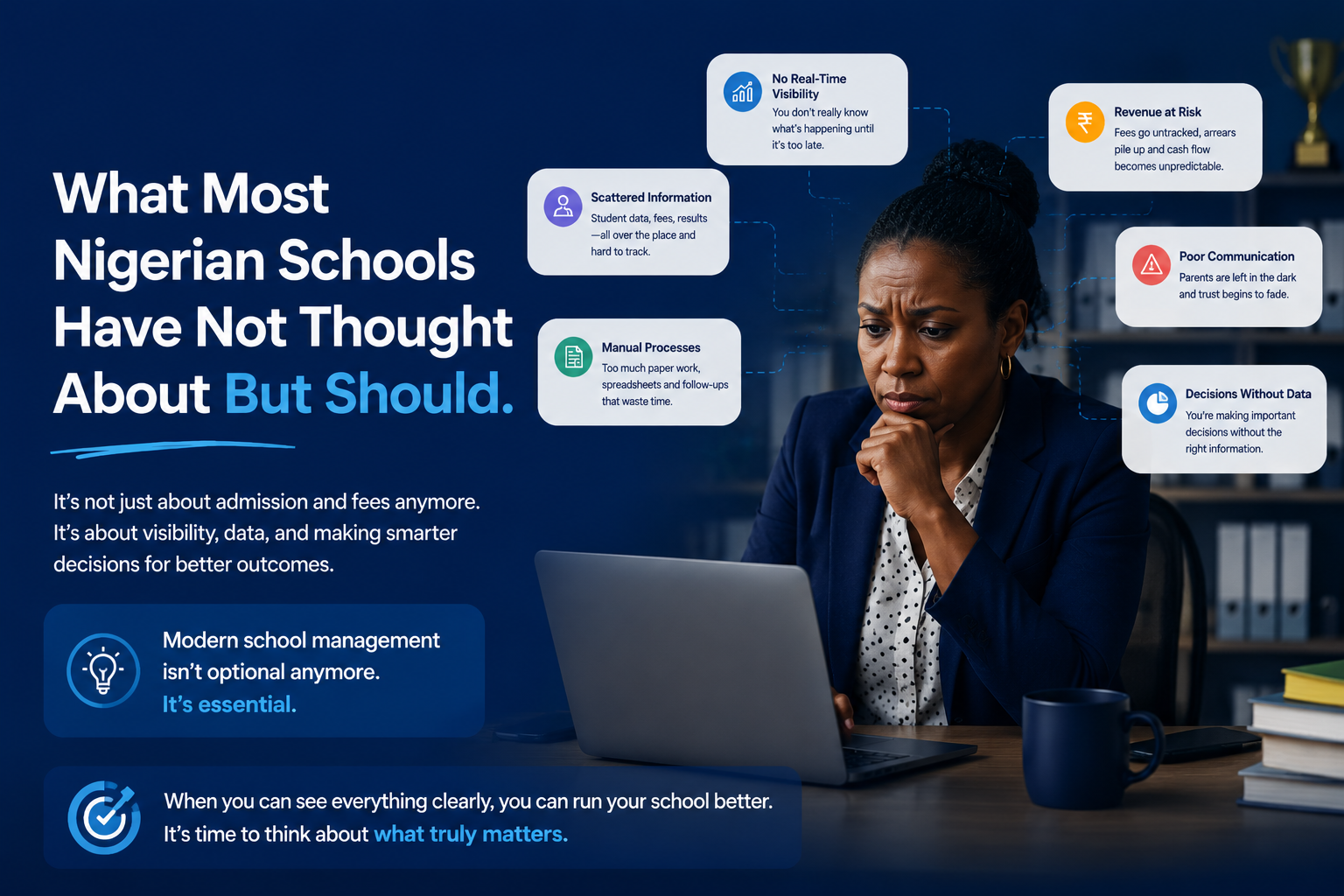
Most articles about school management tools list features and move on. They skip the harder questions that matter most to schools in Nigeria. Here they are.
What happens when the light goes out?
Nigeria’s power supply is unreliable. Your internet connection will not always be stable. Any school management platform worth using should work on low bandwidth and have mobile app access so that staff are not grounded every time NEPA takes the light. Before you sign up for anything, ask directly: Does this platform have offline functionality or a mobile app that does not require a strong connection to operate?
Who owns your school’s data?
Your student records, fee history, staff information, and academic data are valuable. If the platform you use shuts down or you decide to leave, what happens to that data? Can you export it? Do you own it? These are not small questions. Get clear answers before you commit.
What if your teachers are not tech-savvy?
Many Nigerian secondary school teachers, particularly those who have been in the profession for a long time, are not comfortable with new technology. A platform that is complicated to use will be abandoned within weeks, and you will be back to paper. The right tool should be simple enough that a teacher with basic smartphone experience can learn it without a week of training. Ask for a demo and see how long it takes you to understand the interface.
Can parents with basic phones use it?
Not every parent in your school has a smartphone with the latest operating system. A parent portal that only works on high-end phones excludes a large part of your parent community. Check whether the platform’s parent-facing features work on SMS, basic apps, or simple web browsers, not just on the latest Android or iPhone.
Does it integrate with Nigerian payment systems?
Fee collection is one of the most important functions in your school. A good platform should allow parents to pay online through gateways Nigerians actually use, such as Paystack, Flutterwave, or direct bank transfer, and it should generate receipts automatically. If a platform’s payment system is limited or requires parents to jump through too many steps, most of them will not use it.
What does local support actually look like?
Some platforms are built abroad and sold to Nigerian schools without any real on-ground support. When something breaks, and something always breaks eventually, you end up sending emails to a help desk in a different time zone. Prioritize platforms that have a local team, Nigerian phone numbers, and a track record of responding quickly. Customer service is not a bonus feature; it is part of the product.
How to Evaluate an Online School Management Tool: A Practical Checklist
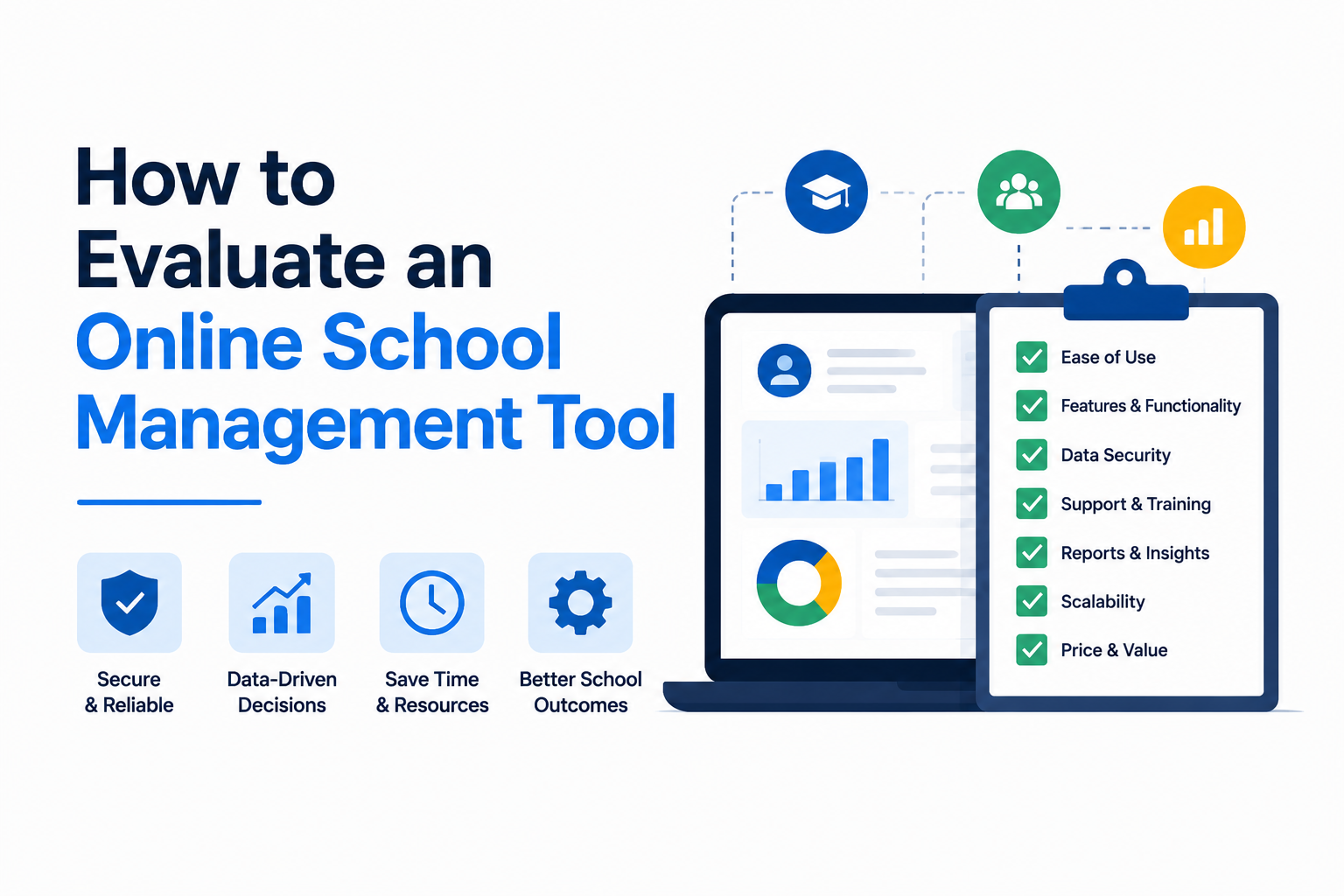
Before you commit to any platform, go through these questions with the vendor:
- Can I request a free demo or trial?
- How long does it take to set up the platform for a school of my size?
- Is there a mobile app, and does it work on low bandwidth?
- Can parents access information without a smartphone?
- Does the platform support online fee payment through Nigerian gateways?
- What happens to my data if I cancel my subscription?
- Do you have schools in Nigeria already using this platform? Can I speak to one?
- What is your response time when something goes wrong?
- Does the platform include staff payroll management?
- Is there a CBT module for internal exams?
A vendor that struggles to answer these questions clearly is a vendor worth being careful about.
What Good Looks Like in Practice
Picture the start of a new academic session in a secondary school that uses an online school management tool properly.
New students register through an online admission form. Their data flows directly into the student records system with no double entry and no lost forms. Parents receive a login to their portal the same day admission is confirmed. Returning students pick up where they left off; their academic history, behavior records, and fee balance are all there.
During the term, teachers take attendance on the platform each morning. The vice principal can see in real time which classes have attendance issues. Parents receive automatic notifications if their child is absent. Fee reminders go out automatically two weeks before payment deadlines, and the bursar can see, at any point, exactly how much has been collected and what is still outstanding.
At the end of the term, teachers enter grades. The system computes results, generates report cards, and makes them available to parents through the portal. No printing. No distribution day chaos. The principal reviews a summary dashboard showing student performance trends across the school.
This is not futuristic. Schools operating this way right now are handling twice the administrative work with half the stress, and their parents trust them more because they are no longer kept in the dark.
A Tool Built for Nigerian Schools: ExcelMind
If you have read this far and you are thinking about where to start, ExcelMind is worth a close look.
ExcelMind is a school management platform built for Nigerian schools. It handles the full range of what has been described in this article: student records, fee management, attendance, results computation, timetabling, parent communication, staff payroll, lesson notes, assignments, CBT exams, hostel management, and more, all within a single platform.
Here is what makes it relevant for Nigerian secondary schools specifically:
- It has a mobile app, which means your staff is not dependent on a desktop computer or stable power supply to keep operations running.
- Parents get their own portal to track fees, view results, and communicate with the school without needing to physically show up for every update.
- Result computation is automated, which removes the manual errors that come with calculating grades across multiple subjects and terms.
- Fee management and online payment are built in, so parents can pay from anywhere, and receipts are generated automatically.
- Biometric attendance integration means records are accurate and not dependent on manual entries that can be adjusted after the fact.
- It includes a CBT module for internal examinations, which schools preparing students for WAEC and NECO can use directly.
- It covers hostel management, staff payroll, a chat system, inventory management, and a behavioral tracking system, so whether you run a day school or a boarding school, your full operational needs are covered.
It is worth saying plainly: no tool solves every problem in every school. But a platform this comprehensive, built with Nigerian schools in mind, is a stronger starting point than most alternatives on the market.
The Longer You Wait, the More It Costs You
Every term you spend managing your school on paper or on disconnected spreadsheets is a term of wasted staff time, uncollected fees, parents left without information, and small administrative errors that build up. The schools gaining ground in Nigeria right now are the ones that have moved their operations online. Not because it is trendy, but because it works.
Online school management tools are not a luxury for well-funded schools. They are a practical decision for any school that wants to stop wasting resources on problems that have already been solved.
If you are a school owner or principal reading this, the next step is simple. See the tool in action before you decide. A demo costs you nothing, and it will show you faster than any article can what a difference the right platform makes. Book your free ExcelMind demo here and see exactly what your school has been missing.
Which software is used for online teaching?
Schools use platforms like Google Classroom, Microsoft Teams, and Zoom for live lessons and assignments. For Nigerian secondary schools that want everything in one place, a school management platform like ExcelMind covers online teaching alongside fee management, attendance, and results, so you are not juggling five different apps.
What tools are used in a digital classroom?
A digital classroom typically runs on a combination of a learning management system for lessons and assignments, a communication tool for teacher-student interaction, a CBT platform for tests, and an attendance tracker. The most practical setup for Nigerian schools is a single platform that handles all of these together rather than separate tools that do not talk to each other.
What is the best school management system?
The best one is the one that fits how your school actually operates. For Nigerian secondary schools, that means a platform with a mobile app, local payment integration, a parent portal, result computation, and reliable local support. ExcelMind was built with these specific needs in mind, which is why it stands out among options available to Nigerian schools
What are some common management tools used in education?
The most widely used ones cover student information management, fee collection, attendance tracking, timetable scheduling, result computation, and parent communication. Some schools also use CBT tools for internal exams and payroll systems for staff. A platform like ExcelMind brings all of these into one system so your school is not managing ten different tools at the same time.